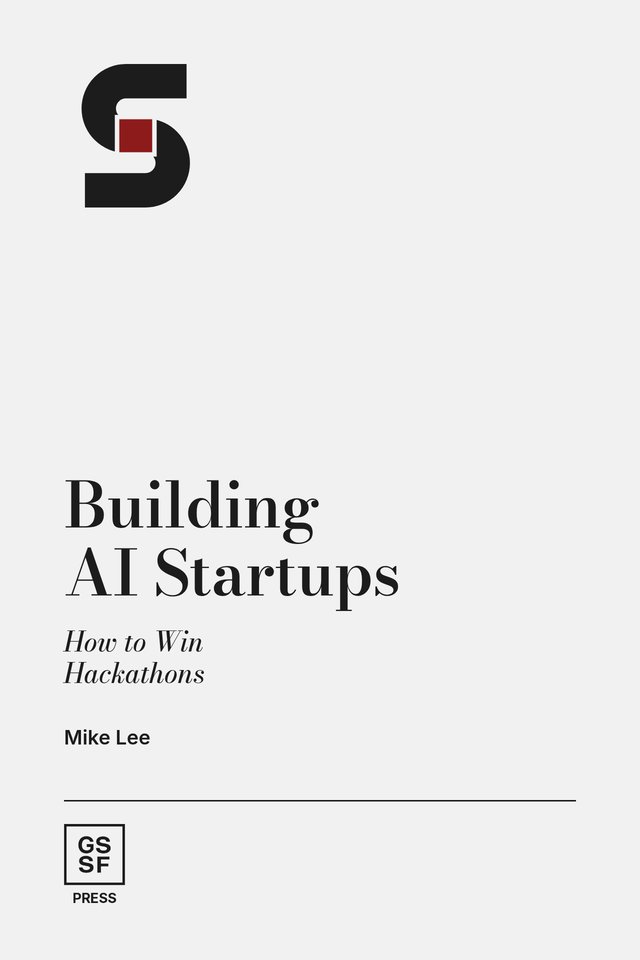
Building AI Startups
How to Win Hackathons.
Book 4 · Forthcoming · Fall 2027
Win a hackathon with a transaction, not only a demo, then turn it into a company: find a problem people pay to solve, build with a team of agents, and pitch from your record. By Mike Lee.
A working draft. Chapters appear here as they are written; the book is forthcoming in Fall 2027. The book follows Building AI Agents, which is required first.
Ten chapters. Three Parts.
Each Part is named by what you build: the idea, the product, and the company. Each chapter has one key idea.
The Idea
Students leave with one problem worth solving, for people they can name, that they can and may work on.
- 1Win the WeekendA hackathon is a whole startup in a weekend; win it with a transaction, not only a demo, and you have a reason to keep going.
- 2The Idea FactoryIdeas are cheap, so make many and keep only those with a problem that recurs for people you can name.
- 3Find the ProblemAsk people what they did last time, not what they think of your idea; then check you can do it and may.
The Product
Students leave with an agent team, a prototype and a first transaction, and take them to the Class Hackathon.
- 4Your Team of AgentsGive each agent one job and keep the decisions that matter: agents draft, a named person signs.
- 5Prototype in a DayBuild the cheapest thing that can take a transaction: code makes the numbers, the model writes the words, a person signs.
- 6Will They Pay?Ask for money or a commitment early; the answer is the only market research that cannot flatter you.
The Company
Students leave with customers reached, numbers that work, repeat customers or a written stop, and a pitch from the record.
- 7Reach Your CustomersWhen anyone can build, the founder who reaches customers where they already are wins.
- 8The NumbersEvery customer must be worth more than they cost to win and to serve, including what the AI costs.
- 9Do They Come Back?Product-market fit is repeat customers; build the company so it runs without you in every step.
- 10The Traction PitchPitch from your record; money comes last, and in more kinds than investors.
What judges look for.
What we look for at hackathons, and what this book teaches you to show.
Live, not a pretty demo
The data is real and current: events are already there and update themselves from other sources, not typed in for the demo.
Seamless data entry
No long forms. Take a picture, or pull the data from where it already lives. Anything that is seamless.
Traction already
Someone has paid, committed or come back. Likes, sign-ups and waitlists don't count.
Who it's for.
A 2-unit, one-semester course. Building AI Agents is required first.
Students
Who have finished Building AI Agents and arrive with an office and a Chief of Staff, ready to build a startup or a hackathon project of their own.
The course
Two units, one semester: ten chapters in three Parts, a Class Hackathon in week 8 and Demo Day in week 15.
Instructors
Looking for a text where students take a startup from an idea to a transaction and a pitch.
Designed to be taught.
Two judged events: a Class Hackathon in week 8, the mid-term, and Demo Day in week 15. An approved outside hackathon can count instead of week 8. Every chapter follows one rhythm.
- A story and its key idea
- Learning objectives
- Numbered sections
- The class build
- Homework on your own startup or hackathon project
- If It Fails
- Check Yourself
Teach with this book
To use it in a course, write to GSSF Press with your course, school and term: [email protected].
The AI Workforce of the Future series.
Four books from GSSF Press, a program of the Global Student Startup Foundation: the ideas, building your own office of AI agents, building whole organizations of people and agents, and building a startup. AI Fundamentals stands apart as their foundation: the first course in AI the series builds on.
The Knowledge Core
Leading a Living, Learning Organization with AI Agents. By Mike Lee.
Visit the book →Book 1 · First Edition · January 2027
Building AI Agents
Directing Agents to Build Anything You Can Describe. By Mike Lee.
Visit the book →Book 2 · 2027 Edition · January 2027
Building Agentic Organizations
Running an Organization of People and Agents. By Mike Lee.
Visit the book →Book 3 · Forthcoming · Fall 2027
Building AI Startups
How to Win Hackathons. By Mike Lee.
Read the book →Book 4 · This book · Forthcoming · Fall 2027The foundation
AI Fundamentals
A First Course in Artificial Intelligence. By Nitin Kalé.
Visit the book →The foundation · Pilot · Fall 2027GSSF Press. We make AI education accessible to undergraduate students regardless of financial ability or location, so every student can build with AI.